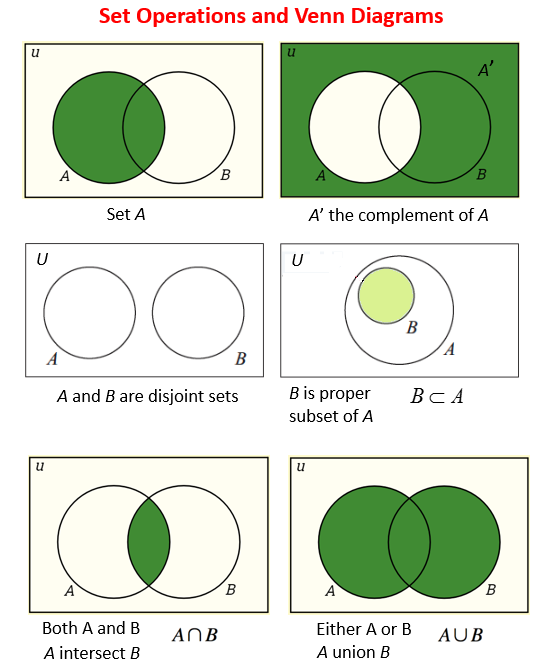
The most common setoperations, such as union, intersection, disjoint, set difference, etc., will be explored in detail below, including their definitions, examples, and Venndiagrams.
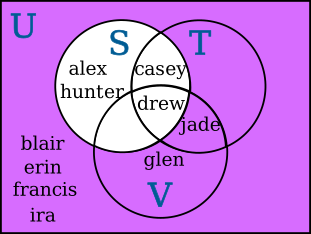
Below is a Venndiagram with two intersecting sets, which breaks the universal set up into four distinct regions. Next, we see a Venndiagram with three intersecting sets, which breaks up the universal set into eight distinct regions.
Venndiagrams use overlapping circles or other shapes to represent sets and their relationships. The overlapping regions of the shapes represent the elements that are common to multiple sets, while the non-overlapping regions represent elements that are unique to each set.
The following diagrams show the set operations and Venn Diagrams for Complement of a Set, Disjoint Sets, Subsets, Intersection and Union of Sets. Scroll down the page for more examples and solutions.
In this chapter, we explained how Venn diagrams are used to represent sets and their operations in discrete mathematics. We discussed fundamental set operations such as union, intersection, difference, and complement, and illustrated how they are visually represented in Venn diagrams.
John Venn popularized this method in the \ (1880 {\rm {s}}\) to help illustrate the inclusion and exclusion relationships of sets. These are also called logic diagrams, setdiagrams, or primary diagrams.
Venndiagrams are a powerful tool for visualizing complex sets and understanding the logic behind setoperations. The union of two sets is the set that contains all the elements from both sets. It can be represented by combining the circles that represent the individual sets.